AI security is moving from visibility to enforcement. Anthropic’s Inference Hooks are an important step in that direction. They allow an enterprise security service to evaluate a governed request before inference runs, rather than relying solely on logs, audits, or post-incident analysis.
That changes the control point for AI governance. Instead of detecting a policy violation after the interaction, organizations can make a decision while the request is still in flight. For enterprises, this creates a practical control point for data protection, AI usage, and policy enforcement.
From Detective Controls to Preventive Controls
Three enterprise requirements illustrate the value.
Data loss prevention. Sensitive, regulated, or contractually restricted information should not reach an unauthorized model. An inline control can prevent the disclosure rather than report it after the fact.
AI usage assurance. Enterprises need visibility into how AI is actually being used—not just which tools have been approved. Runtime enforcement provides visibility into users, applications, projects, models, requests, and policy decisions at the point of use.
Enterprise policy enforcement. Model allowlists, project restrictions, data residency, working-hour requirements, device compliance, and segregation rules should not remain policies on paper. They need to become enforceable controls.
This reflects the broader evolution of AI TRiSM. Gartner identifies AI Runtime Inspection and Enforcement as a distinct technology layer, with runtime controls designed to inspect AI interactions and automatically block anomalies or security events where possible.
The direction is clear: AI governance needs to become a runtime capability.
One Policy Model Across Multiple Enforcement Points
Inference Hooks are new for Anthropic, but the underlying architecture is not new.
Reva has been applying the same model across multiple AI runtime environments: meet the workload at its native enforcement point, send the relevant context to Reva, evaluate enterprise policy, and enforce the decision before the request or action proceeds.
Today, those enforcement points include:
- AI gateways: Kong, LiteLLM, TrueFoundry and other gateway environments
- Agent platforms: Microsoft Copilot Studio and other enterprise agent runtimes
- Coding agents: Claude Code prehooks and similar agent execution controls
- Application and API environments: native integrations, SDKs and webhooks
Reva's enforcement layer is designed to work across these runtime surfaces without requiring enterprises to standardize on a single AI stack.
The architecture is simple:
AI workload → Enforcement Point → Reva → Policy Decision → Allow / Deny / Defer (HITL)
The enforcement point changes. The policy control does not.
Reva + Anthropic Inference Hooks
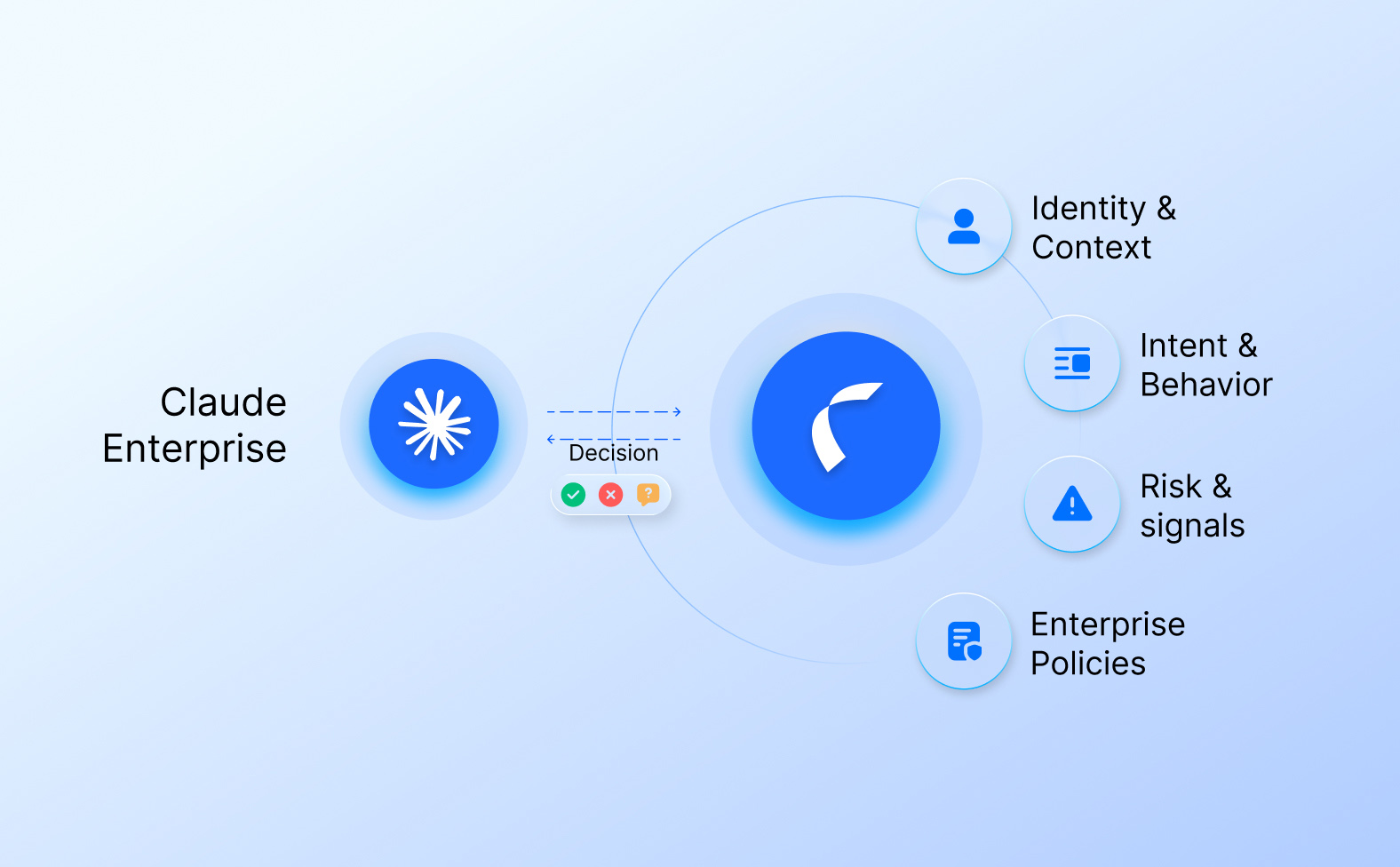
Anthropic’s Inference Hooks provide the interception point. Reva provides the policy and security decision behind it.
A Claude request can be evaluated against enterprise policy before it reaches the model, taking into account:
- Identity and application context
- Agent or project
- Model being accessed
- Data involved
- Location, time, and device context
- Enterprise policy
- Risk
This is where AI security begins to converge with modern runtime authorization. Traditional runtime authorization separates policy management from runtime enforcement. A policy enforcement point intercepts a request, obtains a decision from a policy decision service, and enforces the result. Reva applies the same architectural principle to AI.
The Same Pattern Across AI Gateways
AI gateways are becoming an important enterprise control point because they sit between applications and the models they consume. Reva integrates at this layer with platforms such as Kong, LiteLLM, and TrueFoundry.
The pattern is straightforward:
Agent / Application → AI Gateway → Reva → Policy Decision
This gives security teams a centralized policy layer without requiring every AI application to independently implement security controls. As enterprises adopt multiple models, gateways, agent frameworks, and AI services, the objective is not another security control for every platform. It is one policy model across multiple enforcement points.
The Same Pattern for Copilot Studio and Claude Code
Microsoft Copilot Studio agents can invoke enterprise systems and services on behalf of users. Reva can use available runtime integration points to bring those agent interactions into the same policy enforcement model.
Claude Code provides another example. Its pre-tool execution hooks create a control point before a coding agent executes a tool action. Reva can use that point to evaluate the action against enterprise policy before execution.
The distinction is important.
With an inference hook, the question is:
Should this request reach the model?
With a coding-agent hook, the question becomes:
Should this agent perform this action?
That distinction becomes critical as AI moves from generating responses to executing work.
From Inference Control to Agent Authorization
This is where Reva goes beyond the basic inference-hook model. For traditional AI applications, protecting the model interaction may be sufficient. For autonomous agents, it is not.
An agent can interpret a request, select tools, retrieve data, invoke APIs, trigger workflows, and delegate work to other systems. A single user request can therefore produce a sequence of actions across multiple enterprise resources.
The authorization question changes from:
Can this user access this AI application?
to:
Should this agent perform this action, against this resource, for this user, in this context?
Reva evaluates that decision using the broader runtime context - including identity, intent, behavior, resource, action, and risk. Reva Trust Guardian can also monitor agent behavior for intent or behavioral drift and apply policy controls when an agent moves outside its intended boundaries. This is the next layer beyond inference security: authorizing what AI is allowed to do.
One Policy Layer. Multiple AI Surfaces.
Enterprise AI will not converge on one model, one agent platform, or one gateway. Organizations will use Claude, Microsoft Copilot, AWS Bedrock, custom agents, coding agents, AI gateways, MCP servers, and embedded AI across their technology environments.
Security architecture therefore needs to be independent of any individual AI platform. Reva separates the policy control plane from the runtime enforcement points. Policies and context remain centralized, while enforcement can happen wherever the AI interaction occurs.
That creates a consistent architecture across:
Inference → Agent Actions → Tool Calls → API Calls → Enterprise Resources
This is the broader shift Anthropic’s Inference Hooks represent. AI security is no longer only about observing AI. It is about putting policy in the path of AI. And as AI becomes increasingly autonomous, that path must extend beyond inference to the consequential actions an agent takes.
Inference Hooks are an important enforcement point. Reva makes them part of a broader runtime authorization architecture for AI.
.svg)