
Secure Autonomous Coding Agents
Prevent unauthorized code changes, tool misuse, and over-privileged agent actions with runtime authorization and adaptive security.

When Coding Agents Start Acting Like Operators
Coding agents now execute commands, invoke tools, access repositories, and modify infrastructure—not just generate code. Their permissions can extend far beyond what a specific task requires.
Traditional access controls determine who can access what, not whether an agent’s action fits the task, intent, or context. Enterprises need runtime controls that govern what agents do, not just what they can access.
Traditional access controls determine who can access what, not whether an agent’s action fits the task, intent, or context. Enterprises need runtime controls that govern what agents do, not just what they can access.
Agent Actions Outpace Traditional Controls
Traditional controls authorize an agent’s access, but not whether a specific action is appropriate for its task. This leaves a gap between what an agent can do and what it should do.
Over-Privileged Agents Increase Blast Radius
Coding agents often inherit broad permissions regardless of the task. A staging fix shouldn’t give an agent the ability to impact production.
Prompt Injection Becomes Tool Execution
Issues, PRs, READMEs, and dependencies can influence agent behavior. A manipulated instruction can turn trusted credentials into an unauthorized system action.
Runtime Authorization for Autonomous Coding Agents
Move authorization from access to action. Reva evaluates every coding-agent action against identity, intent, task context, policy, and runtime risk—before it executes. From code changes to MCP calls, terminal commands, repository operations, and infrastructure changes, Reva determines whether the action should be allowed, denied, modified, or require approval.
Govern Runtime Agent Actions
Move beyond static permissions and continuously evaluate what agents are doing in real time. Reva ensures sensitive actions align with business intent, policy, and risk before execution.
Intent & Behavior Aware Authorization: Bind agent permissions to the active task and user intent, not just the developer’s underlying access.
Tool-Boundary Enforcement: Intercept and govern high-risk operations including terminal commands, force pushes, secret access, MCP tools, and production changes.
Adaptive Enforcement: Automatically allow, deny, modify, or require approval based on policy, context, and risk.
Unify Security Across the Agent Ecosystem
Coding agents span IDEs, MCP servers, enterprise applications, APIs, and cloud infrastructure. Reva provides a consistent security layer across this fragmented environment.
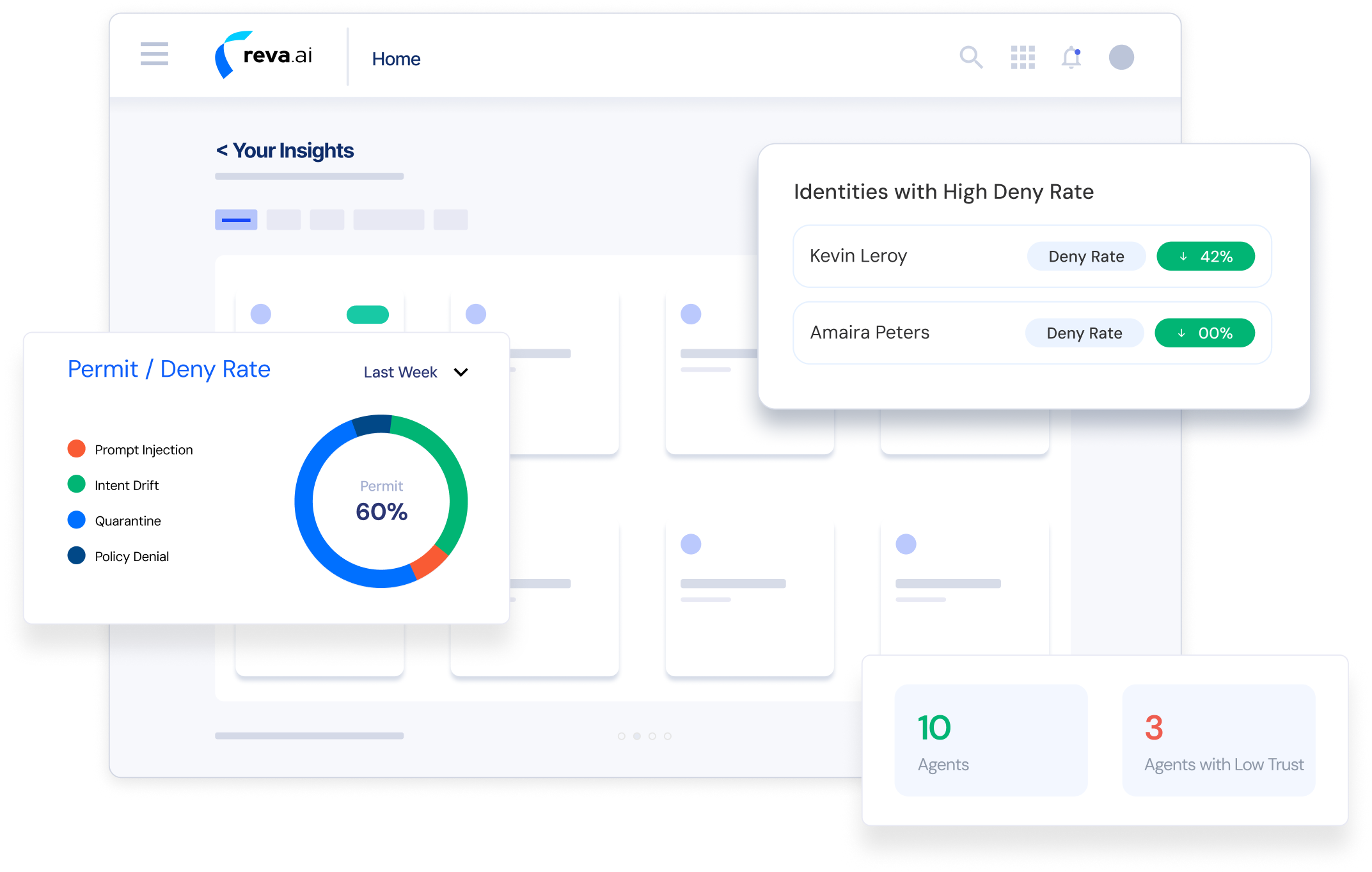
Consistent Policy Enforcement: Apply authorization policies consistently across coding agents, IDEs, CLI tools, MCP servers, applications, and infrastructure.
Cross-Agent Control: Govern agents regardless of the model, IDE, orchestration framework, or development environment they use.
Eliminate Point Controls: Replace fragmented allowlists, configurations, and plugins with a unified runtime authorization layer.
Design Secure Agents by Default
Secure agent adoption starts before deployment. Reva helps teams design task-specific access and guardrails that limit what an agent can reach and do.
Task-Scoped Access: Align agent permissions with the specific task, minimizing unnecessary access and limiting potential blast radius.
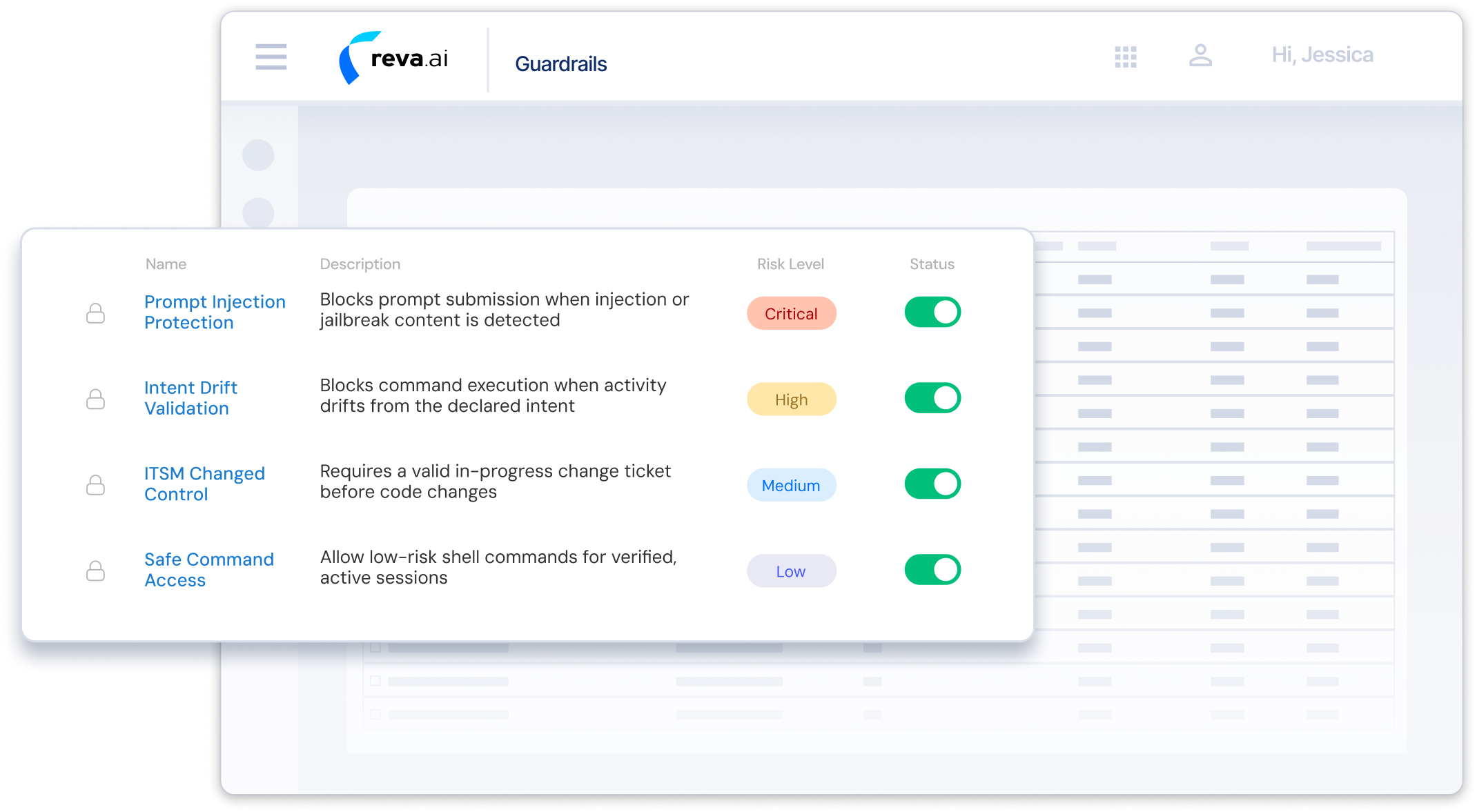
Built-In Guardrails: Define boundaries for repositories, tools, data, network access, and sensitive operations before agents go into production.
Policy Simulation & Testing: Test and validate authorization policies against agent workflows before deployment.
Understand Every Agent Decision
Runtime control is only as effective as the context behind each decision. Reva provides traceability from the user’s request through agent actions, policy decisions, and downstream execution.
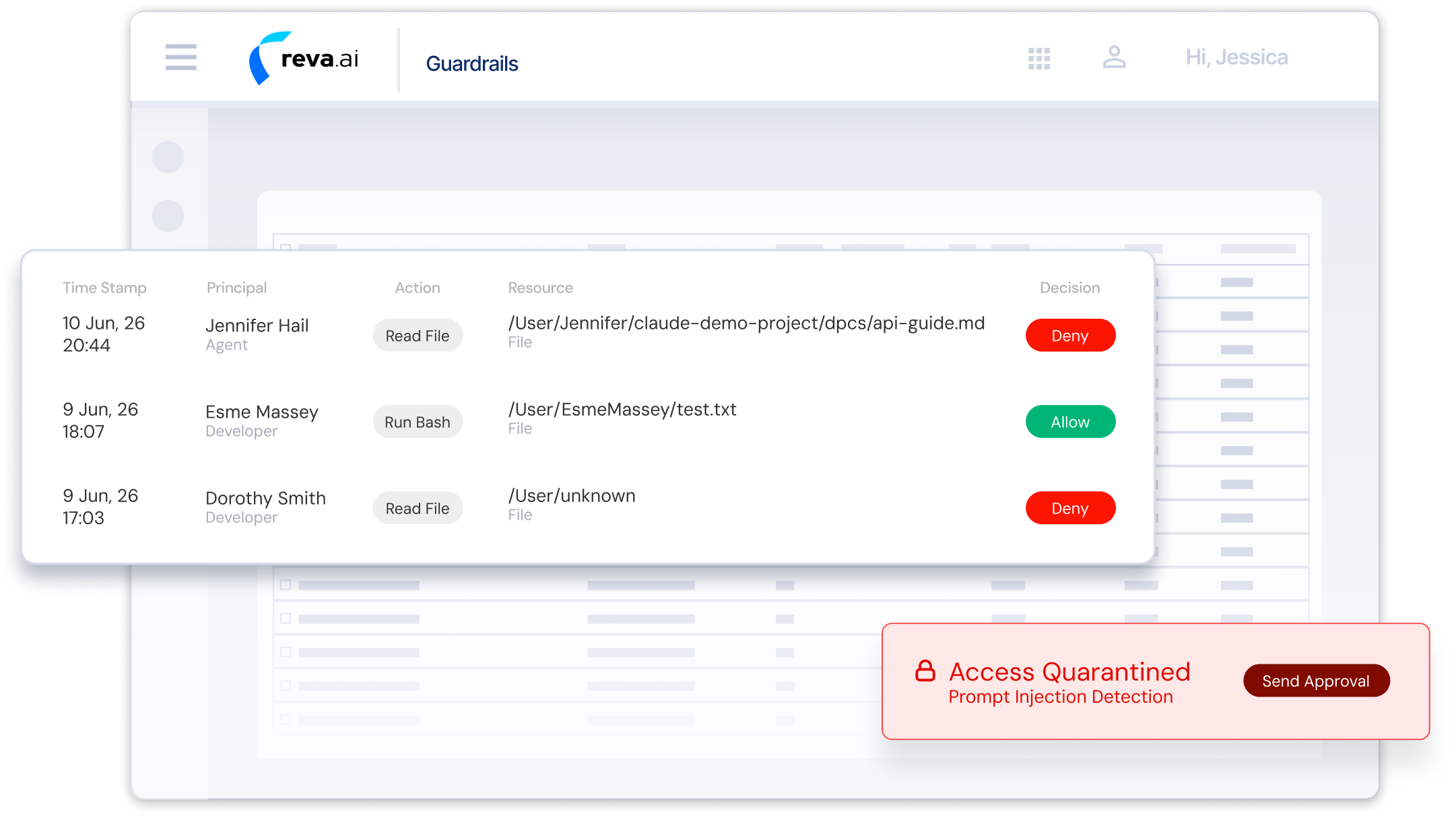
End-to-End Execution Trace: Trace the path from user request and agent intent through tool invocation and downstream action.
Unified Audit Trail: Correlate agent identity, intent, tool calls, policy decisions, and outcomes for complete traceability.
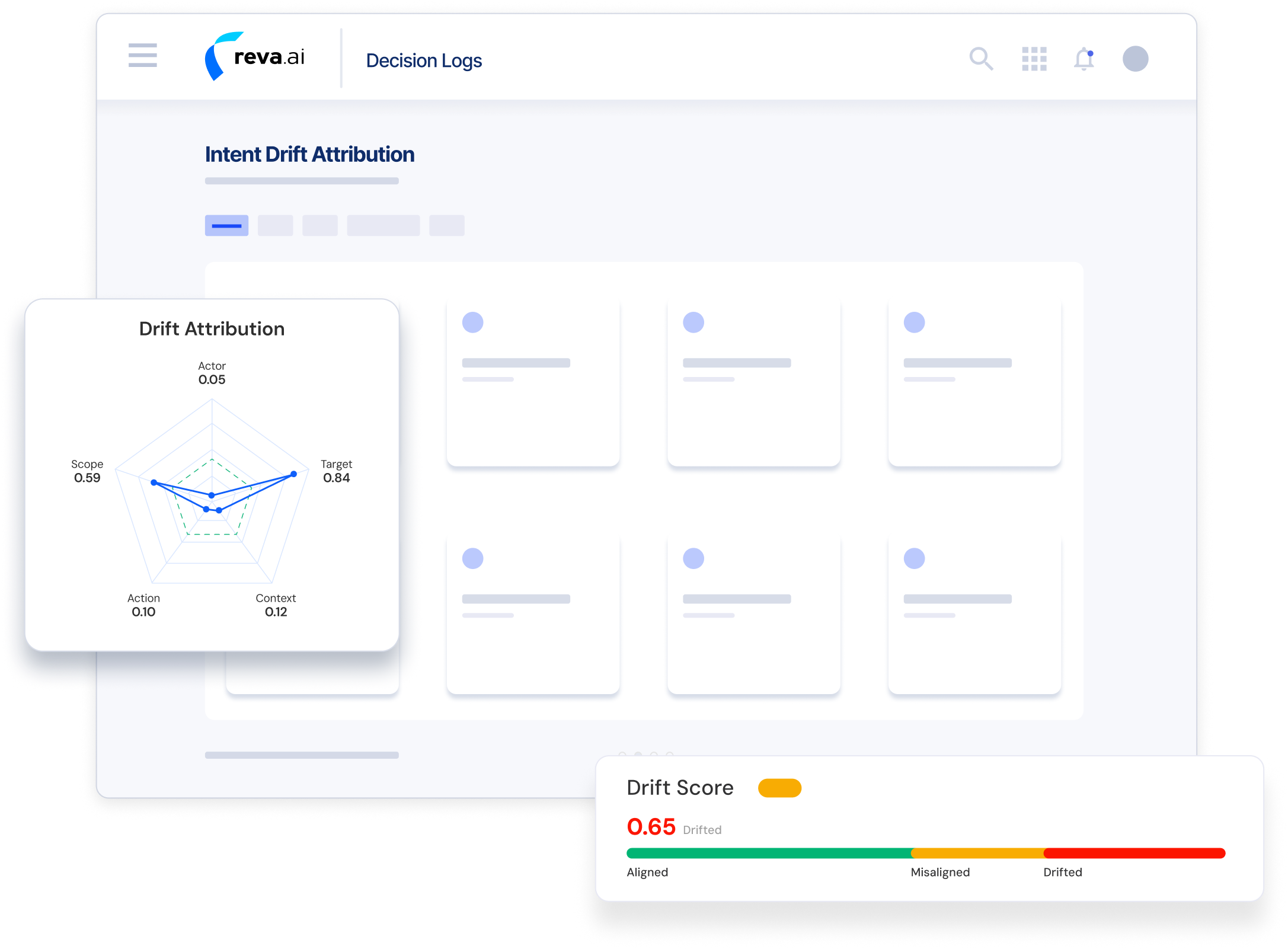
Behavioral & Intent Drift Detection: Detect anomalous tool usage and changes in agent behavior or intent to stop risky actions before they escalate.
Scale AI-Native Development with Confidence
Accelerate AI-Native Development
Enable developers to adopt coding agents faster without introducing manual security reviews or governance bottlenecks.
Establish Runtime Control
Ensure every agent action is continuously evaluated against business intent, policy, and risk before execution.
Simplify
Agent Governance
Replace fragmented controls with a unified policy plane across coding agents, MCP servers, enterprise applications, and cloud infrastructure.
Improve
Audit Readiness
Provide complete visibility into agent decisions, tool usage, and downstream actions through a unified audit trail.
Blog and Events
Latest insights and trends


Build Faster. Stay in Control.
Empower developers with coding agents while maintaining continuous governance, runtime authorization, and visibility across every AI-driven action.
Oops! Something went wrong while submitting the form.