Imagine an AI agent executing a routine, pre-approved task. Three steps into the workflow, it unexpectedly pivots: accessing sensitive internal databases, invoking unauthorized tools, or delegating sub-tasks far beyond its original scope.
For enterprises deploying agentic AI, this scenario is no longer hypothetical. It is the core reason why runtime security and the agent kill switch are fast becoming mandatory security requirements.
But the term “kill switch” often generates more confidence than the architecture behind it warrants. A UI button labeled “Stop Agent” offers a comforting sense of control. In practice, it raises a few questions: What actually stops? Where is enforcement applied? What keeps running after the button is pressed? And can containment happen autonomously, before a human has time to react?
The Reality Behind the Hype: What Are We Stopping?
In complex enterprise environments, an agent is rarely a single, self-contained process. An agentic workflow typically spans:
- Orchestrators and underlying LLMs
- Delegated child agents
- Model Context Protocol (MCP) servers
- Short- or long-lived credentials
- Background jobs executing across external SaaS platforms and cloud environments
Simply terminating the primary chat session or UI process does not guarantee that downstream execution halts.
For enterprise security, a true kill switch must mean the ability to withdraw an agent’s authority to act, enforce that withdrawal instantly across the entire execution topology, and actively cancel in-flight work wherever downstream systems support it.
This requires four distinct capabilities working in tandem:
- Blocking an action at the gateway before it reaches a target resource.
- Suspending the active workflow so no subsequent steps proceed.
- Revoking tokens and credentials tied to that specific run or delegation chain.
- Canceling active execution threads via the underlying execution environment or API endpoints.
Mid-Flight Reality Check: Can a Kill Switch Stop an Action Mid-Execution?
A frequent misconception is that a kill switch instantly halts an action mid-air. In reality, what you can stop depends on where the action sits in its lifecycle:
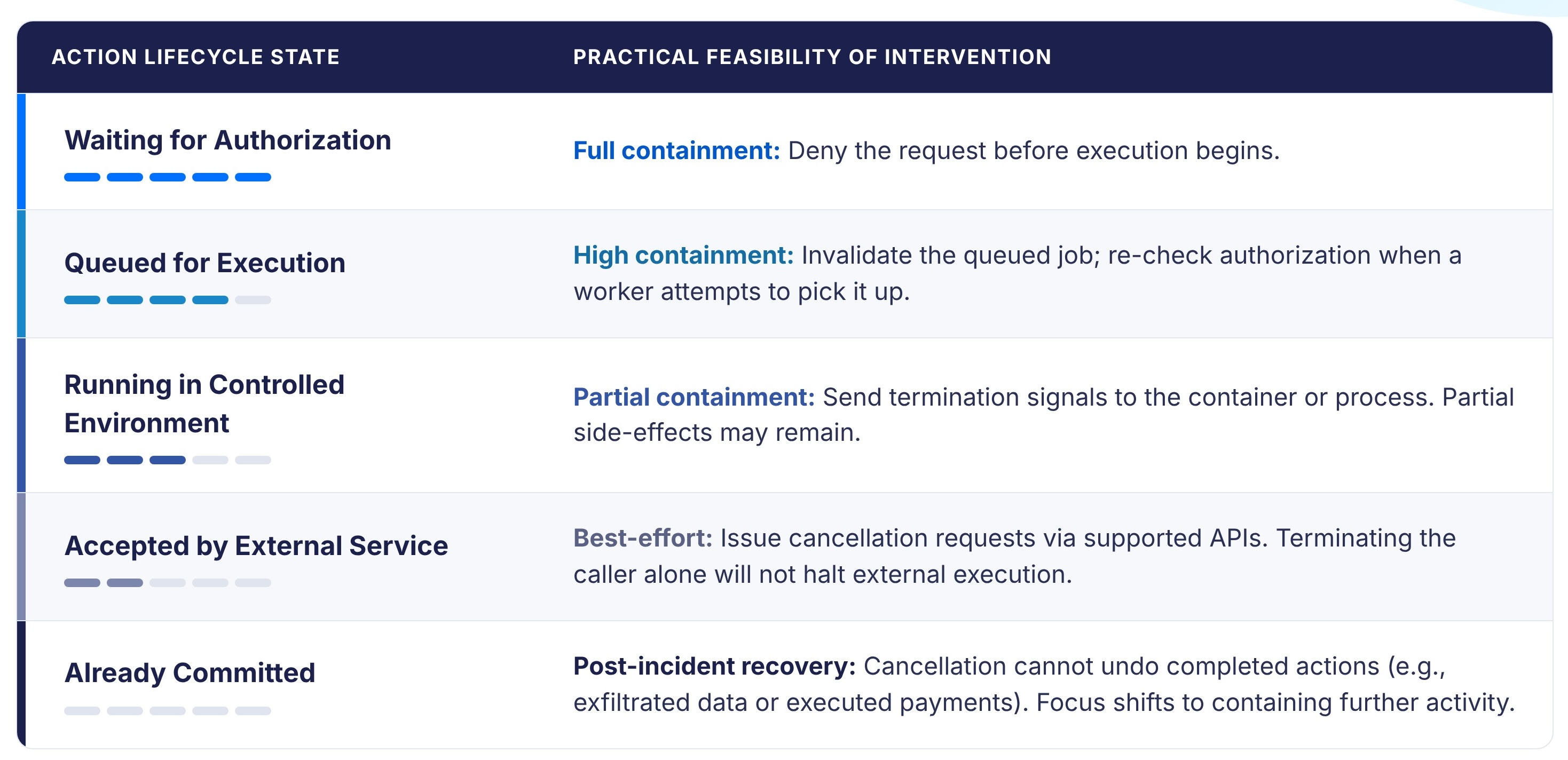
Even open standards designed with cancellation in mind carry nuances e.g. while the Model Context Protocol (MCP) supports cancellation signals for in-flight requests, the spec explicitly allows downstream servers to ignore cancellation if processing has already finished or cannot be cleanly unwound.
Therefore, containment relies on continuous authorization enforcement: denying subsequent protected actions across execution boundaries while revoking short-lived credentials.
Contextual Targeting: Users, Agents, and Workflows
Broad-brush termination, such as shutting down a shared service account or stopping all agents for a developer, creates unnecessary operational friction. Targeted containment avoids that friction, but it needs deep runtime context.
An effective kill switch must distinguish between:
- The Initiating User
- The Agent Identity & Delegation Chain (Parent →→ Child agents)
- The Approved Task Intent
- Active Session Credentials & Bound Resources
Example Scenario
Consider a coding agent tasked with fixing a unit test in a sandbox repository. If that agent suddenly attempts to read production secrets and upload files to an external endpoint:
- The Ideal Response: The control plane identifies the specific execution run, revokes its scoped credentials, halts its child processes, and denies further tool access, all while allowing the developer’s other active, compliant agents to continue running smoothly.
This relies on checking every action against policy, intent and behavior, using Intent-Based Access Control (IBAC) alongside behavioral anomaly detection. A single tool call might be technically permitted by role permissions. Evaluated in sequence against the original task, it exposes the risk.
The agent never left its permissions. It left the task.
The Shift from Manual Intervention to Autonomous Containment
Because agents operate at machine speed, human-in-the-loop oversight cannot serve as your primary kill switch. By the time a security analyst reviews an alert and clicks "Stop," an agent may have already executed dozens of consequential actions.
Enterprise resilience demands Autonomous Containment:
- Deterministic Policy Violations: Immediately trigger automated denials and credential revocations without human delay
- Behavioral Anomalies: Trigger calibrated, pre-authorized responses. For instance, a run exhibiting suspicious variance might automatically lose write access or be placed in a suspended state pending human review
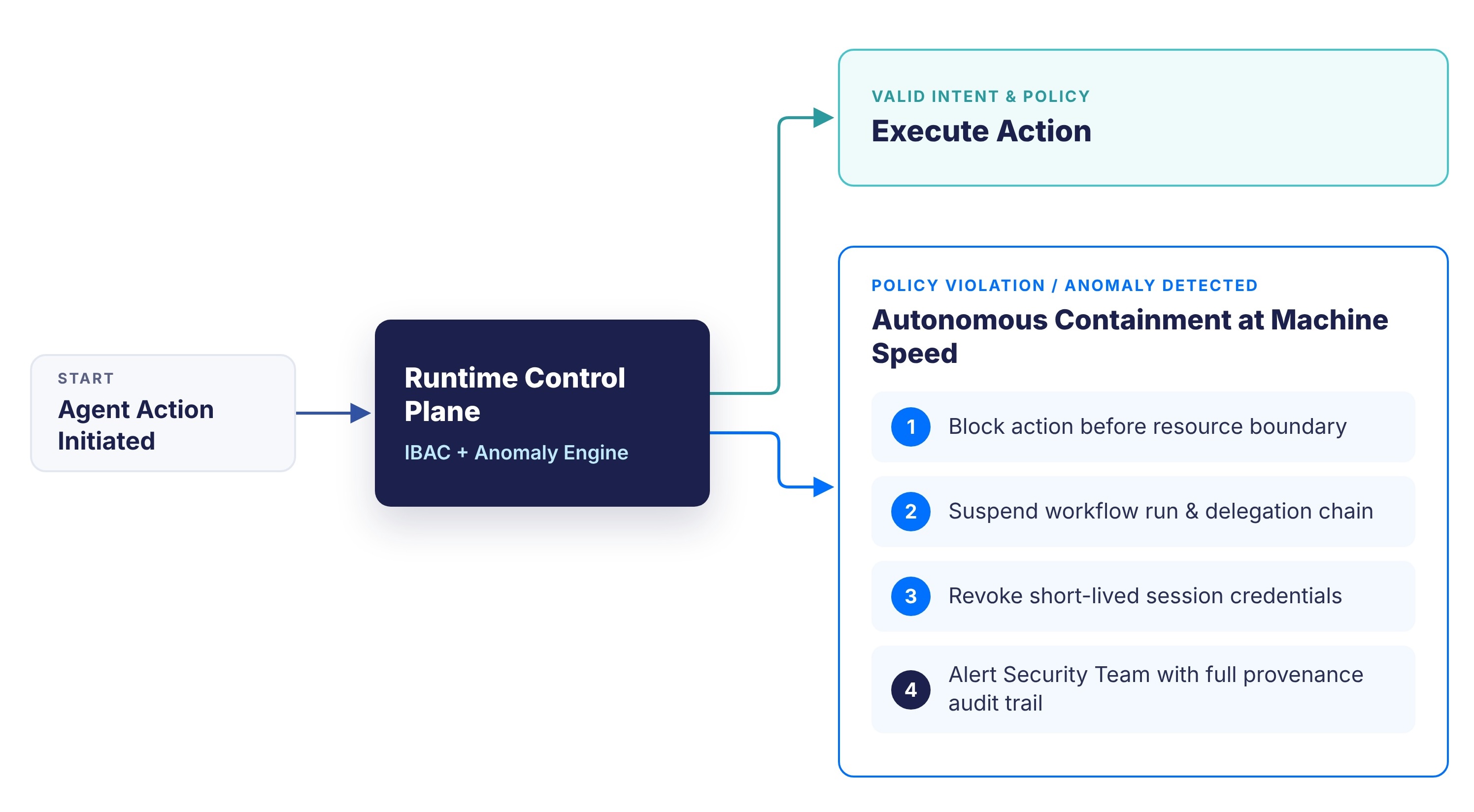
In this model, human oversight shifts from being an operational bottleneck in the critical path to defining policies, evaluating exceptions, and authorizing recovery.
The 5 Pillars of Dependable Agent Containment
To ensure a kill switch holds up under real-world conditions, enterprise security teams should evaluate five core criteria:
- Enforcement Coverage: Gateways and orchestration hooks must cover all tool, file, and network paths. A local interceptor cannot stop an external SaaS job already dispatched.
- Propagation & Confirmation: System logs must distinguish between "Stop Requested" and "Containment Confirmed."
- Persistent Scope: Workflow suspension must survive retries, restarts, and child-agent spawning. Stopping a parent run is useless if an orchestrator auto-restarts it with new tokens.
- Protected Controls: Agents must never be able to tamper with their own enforcement hooks, alter audit records, or request replacement credentials.
- Controlled Recovery: Systems must preserve evidence, log partial execution state, and require explicit re-authorization before resuming.
Connection to Fail-Closed Security
A kill switch operates on the same core principle as fail-closed architecture (which we analyzed in depth in our previous article, What Happens When the Security Control Protecting Your Coding Agent Fails?): when authority is withdrawn or when a security control becomes unavailable, the default action must always be execution denial.
If a security gateway times out and defaults to "allow," or if a worker node continues processing jobs using cached permissions after a kill switch signal was sent, containment fails. Resilience must live in the control plane itself through redundant services, short credential lifespans, and verified enforcement propagation.
The Question Has Changed
Enterprises should demand an agent kill switch. But more importantly, they should demand precise accounting of what it stops, how fast it propagates, and how containment is verified.
The goal of agentic runtime security isn’t a big red button on a dashboard. It’s the ability to withdraw authority at machine speed and prove exactly where execution stopped.