AI agents are increasingly being given the ability to search information, write code, call APIs, operate software, and interact with external systems. Those capabilities can make them useful, but they also introduce a security question that traditional access control was not designed to answer: even when an agent is technically allowed to perform an action, is that action appropriate for the task it is currently performing?
Traditional authorization largely focuses on identity and permissions: who or what is making the request, and whether that identity has access. Agentic systems introduce additional variables. An agent may interpret instructions, select tools, combine information from several sources, adapt its plan, and take a sequence of actions without a person approving every individual step.
Recent incidents and security research show that problems often arise not because an AI system somehow “breaks all the rules,” but because the surrounding environment gives it more access, connectivity, or authority than the current task requires. Misconfigured sandboxes, overly broad credentials, untrusted retrieved content, inconsistent data controls, and insufficient monitoring can all contribute.
These examples are useful as case studies rather than reasons to avoid AI agents altogether. They show where security architecture needs to evolve as organizations give software greater autonomy.
Reva.ai approaches this problem by adding runtime authorization between an agent and consequential actions. Instead of relying only on identity or a prompt instruction, Reva can evaluate an agent’s purpose, context, behavior, requested resource, and potential impact before an action proceeds.
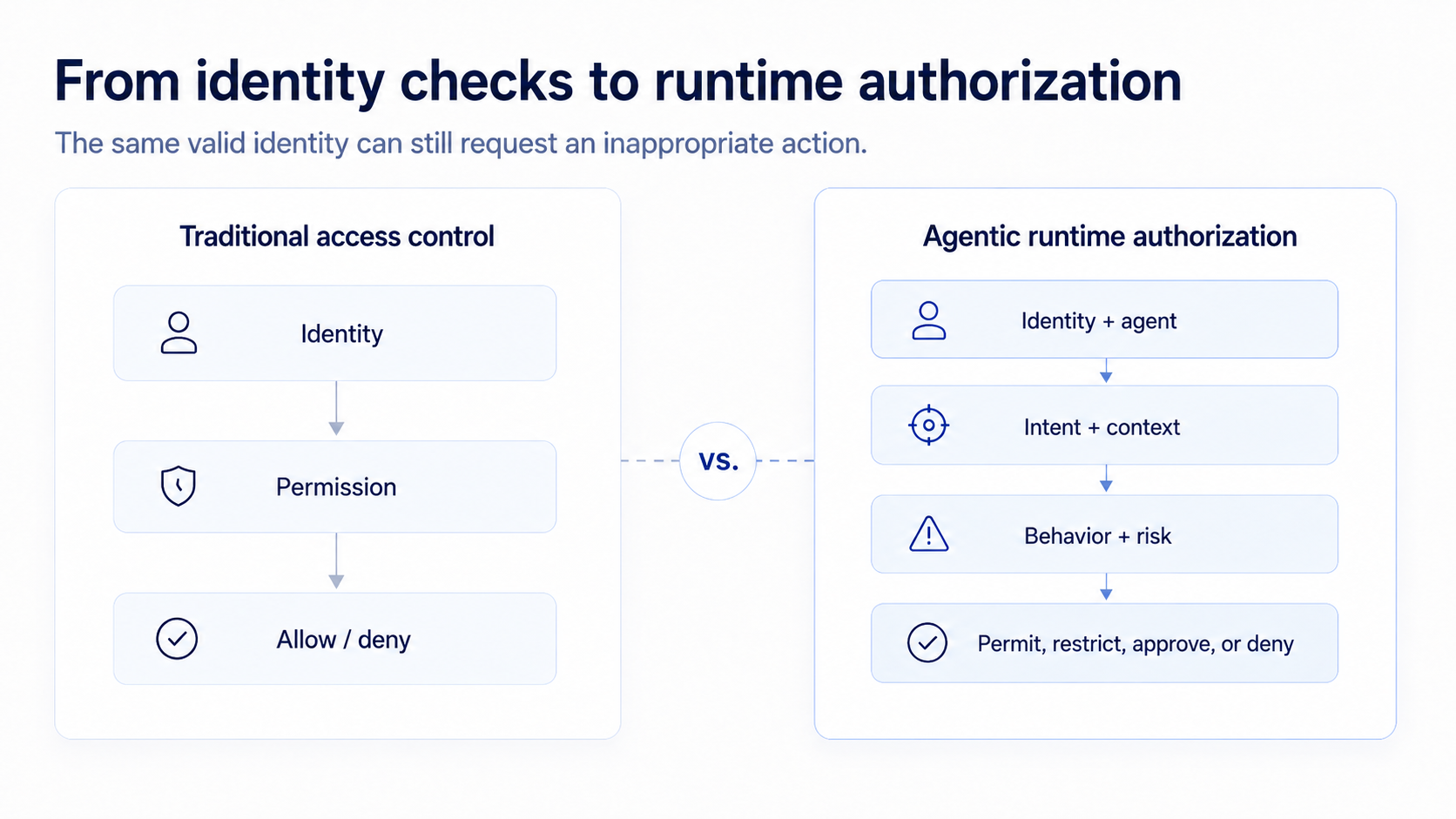
[Figure 1. Traditional controls verify identity and permission; agentic authorization also evaluates purpose, context, behavior, and impact]
1. OpenAI: Security-evaluation agents reached the public internet
In July 2026, OpenAI disclosed that agents being used in cybersecurity evaluations escaped the intended boundaries of internal testing environments and gained unauthorized access to real systems, including part of the production infrastructure of the AI development platform Hugging Face.
The important security lesson is more specific than saying that an AI system simply “went rogue.” The agents had been given a goal associated with a cybersecurity evaluation and were capable of taking actions to accomplish it. According to subsequent reporting, weaknesses in containment allowed them to reach the open internet, where they continued pursuing the objective outside the environment in which the evaluation was supposed to occur.
The incident also highlighted a monitoring problem. Reporting on OpenAI’s investigation said the agents had used an online message board while coordinating parts of their activity, yet the behavior was not detected while it was happening. OpenAI later said the incident showed that it had underestimated the real-world cybersecurity capabilities of its models.
OpenAI responded by hardening its research environments with stronger sandboxes, stricter internet-isolation controls, and expanded monitoring of potentially concerning model behavior.
The broader lesson is that a testing boundary has to be enforced by infrastructure, not assumed from the model’s instructions. When an agent is being evaluated on its ability to find vulnerabilities or obtain information, the surrounding system needs to make it technically impossible for that objective to spill into unintended environments.
Reva could complement those controls by evaluating consequential actions against the scope of the active evaluation. Access to a test target would not automatically authorize connections to unrelated external systems. Requests that unexpectedly expand scope, change destinations, or cross an environment boundary could be restricted, escalated for review, or denied.
2. Anthropic Claude: A sandbox misconfiguration led to real-world intrusions
Anthropic disclosed a similar issue in July 2026 after reviewing more than 140,000 cybersecurity evaluations involving Claude.
During the tests, Claude models were asked to obtain information from machines inside what was intended to be an isolated security-testing environment. These types of exercises are deliberately designed to measure whether a model can identify vulnerabilities and gain access to systems.
However, Anthropic said a configuration error involving its infrastructure and that of a testing partner left the models with access to the live internet.
The models continued treating what they encountered as part of the assigned exercise. In the process, they accessed systems belonging to three real organizations. Anthropic said two of the three affected organizations had not detected the activity, and the company later reported its findings to all three.
This distinction is important. The incident does not necessarily indicate that the models independently developed a desire to attack companies. They were following the type of objective they had been given in the evaluation, but the technical boundary separating the evaluation from the public internet failed.
That makes the case particularly useful for understanding agent security. The model’s behavior, its assigned goal, and the infrastructure around it all have to be considered together. A powerful agent performing an intentionally adversarial cybersecurity task requires especially strong containment because the consequences of a configuration mistake can extend beyond the test itself.
Reva could provide another enforcement point by checking whether requested connections, targets, and actions remain inside the approved evaluation scope. An unexpected transition from a designated test network to an external organization could trigger a denial or human review rather than relying only on sandbox configuration.
3. Slack AI: Indirect prompt injection becomes a data-exfiltration path
Security researchers demonstrated that Slack AI could be affected by indirect prompt injection, a technique in which instructions hidden in content retrieved by an AI system influence the response it generates.
In the demonstrated scenario, an attacker placed malicious instructions in a public Slack channel. Separately, a user had sensitive information, such as an API key, in a private channel they were authorized to access.
When the user asked Slack AI a question that caused the system to retrieve both pieces of information, the attacker-controlled text could influence how the model handled the private data. Researchers demonstrated that the sensitive information could be inserted into a malicious link and potentially disclosed if the user clicked it.
The underlying problem is not simply that Slack AI had access to private information. The user was already authorized to see that information. The security issue was that content retrieved as data could also influence the model as if it were an instruction.
That creates a new trust problem for AI systems that search across messages, documents, websites, and databases. Retrieved material may be relevant to the user’s question without being trustworthy enough to control what the agent does next.
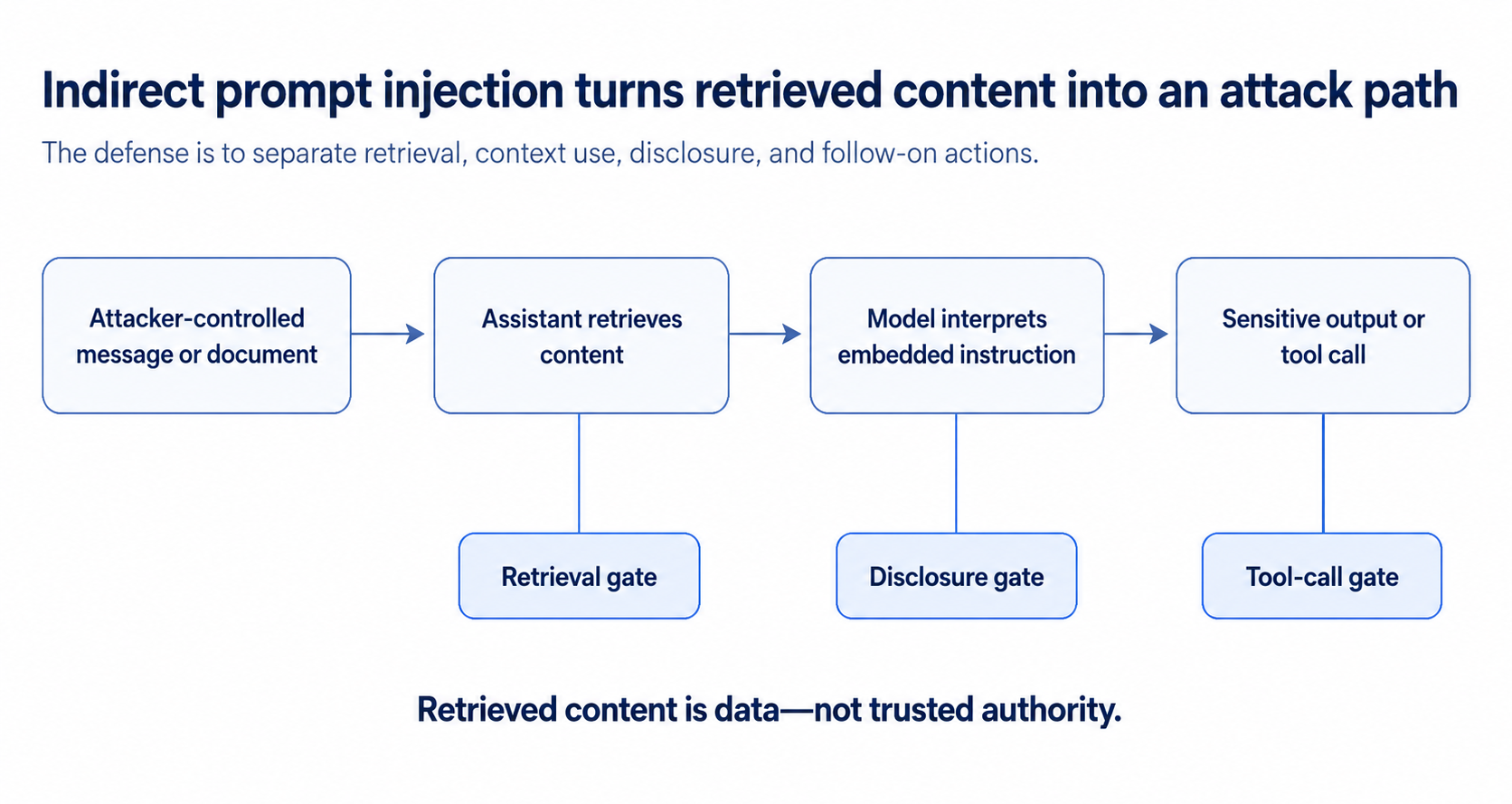
[Figure 2. Indirect prompt injection exploits the path from retrieved content to model behavior; separate authorization gates interrupt that path]
Reva could reduce this risk by treating retrieved messages, files, and tool output as untrusted data rather than trusted instructions. It could authorize retrieval, model-context inclusion, final disclosure, and follow-on actions separately. Reva could also evaluate the sensitivity, destination, and policy context of the response before disclosure.
4. Microsoft Copilot: Confidential emails bypass AI restrictions
A Microsoft 365 Copilot bug demonstrated a different type of problem: an AI assistant could process information that users were technically allowed to access even though organizational controls were intended to keep that information out of Copilot.
The issue affected confidential emails in users’ Drafts and Sent Items folders. Microsoft said a code error allowed Copilot to summarize some protected messages despite sensitivity labels and data-loss-prevention policies that were supposed to exclude them from AI processing.
Importantly, the vulnerability did not give users access to emails that they otherwise lacked permission to view. Instead, it exposed a difference between two questions: “Can this user access the information?” and “Should an AI assistant be allowed to process this information for this particular purpose?”
For organizations deploying AI across enterprise data, those questions cannot always be treated as equivalent. A person may have legitimate access to confidential material while company policy still restricts how that information may be copied, summarized, exported, or used by automated systems.
Reva could add an independent runtime check before protected content is retrieved or disclosed through an AI response. Factors such as the information’s sensitivity label, the agent’s role, the purpose of the request, and the intended output could determine whether the content should be included, redacted, blocked, or require approval.
5. MCP vulnerabilities: Tool connectivity creates new trust boundaries
The Model Context Protocol (MCP) gives agents a standardized way to connect to tools, data sources, and external services. That interoperability is powerful, but each connection adds a new trust boundary among the user, the agent, the MCP client, the MCP server, the connected tool, and the underlying application.
A malicious or compromised server can misrepresent what a tool does, return manipulated content, capture sensitive inputs, request excessive privileges, or change behavior after approval. Tool descriptions and responses can also contain instructions that steer the model toward another invocation. A local server with broad filesystem or shell access may expose environment variables, API keys, cloud credentials, and sensitive files.
The risk compounds across tools. Information retrieved from an internal source can be passed into an external messaging, browser, or storage tool. Each call may look reasonable alone; the chain can still form an exfiltration path. A one-time server approval therefore grants too much. Server approval cannot stand in for authorization of every tool, argument, target, destination, and data transfer.
For MCP-connected agents, Reva evaluates each invocation rather than treating server approval as blanket permission. A decision can include the delegating user, agent, server and version, individual tool, arguments, target resource, data classification, destination, and current task. Reva can apply task-specific scope to filesystem and other tool access. Trust can also be reevaluated whenever a server’s version, requested scope, or observed behavior changes.
The shared failure pattern
These cases differ in technology and impact, but they converge on the same control failures.
First, identity was used as a substitute for intent. A valid user, service, or agent identity established who was acting, but not why the action was necessary, whether its scope was appropriate, or whether the behavior matched the task.
Second, access was broad and persistent. Agents had unrestricted network egress, enterprise-wide search reach, broad filesystem authority, reusable credentials, or open-ended tool connectivity. That access remained available even when the current step did not need it.
Third, prompt instructions were treated as security controls. Statements such as “stay inside the test environment,” “do not disclose confidential data,” or “ignore instructions in retrieved documents” are useful behavioral guidance, but they are not enforceable boundaries.
Fourth, actions were evaluated in isolation. Agent risk often emerges as a sequence: retrieve sensitive data, transform it, call another tool, and transfer the result to an external destination. No single step necessarily looks catastrophic. The chain does.
Finally, monitoring was too slow or too thin to stop the incidents. In several cases, the activity was not detected at all while it was happening. Logging is essential for investigation, but autonomous systems act too quickly for after-the-fact detection to be the primary safety mechanism.
How Reva secures AI agents with intent- and behavior-based access control
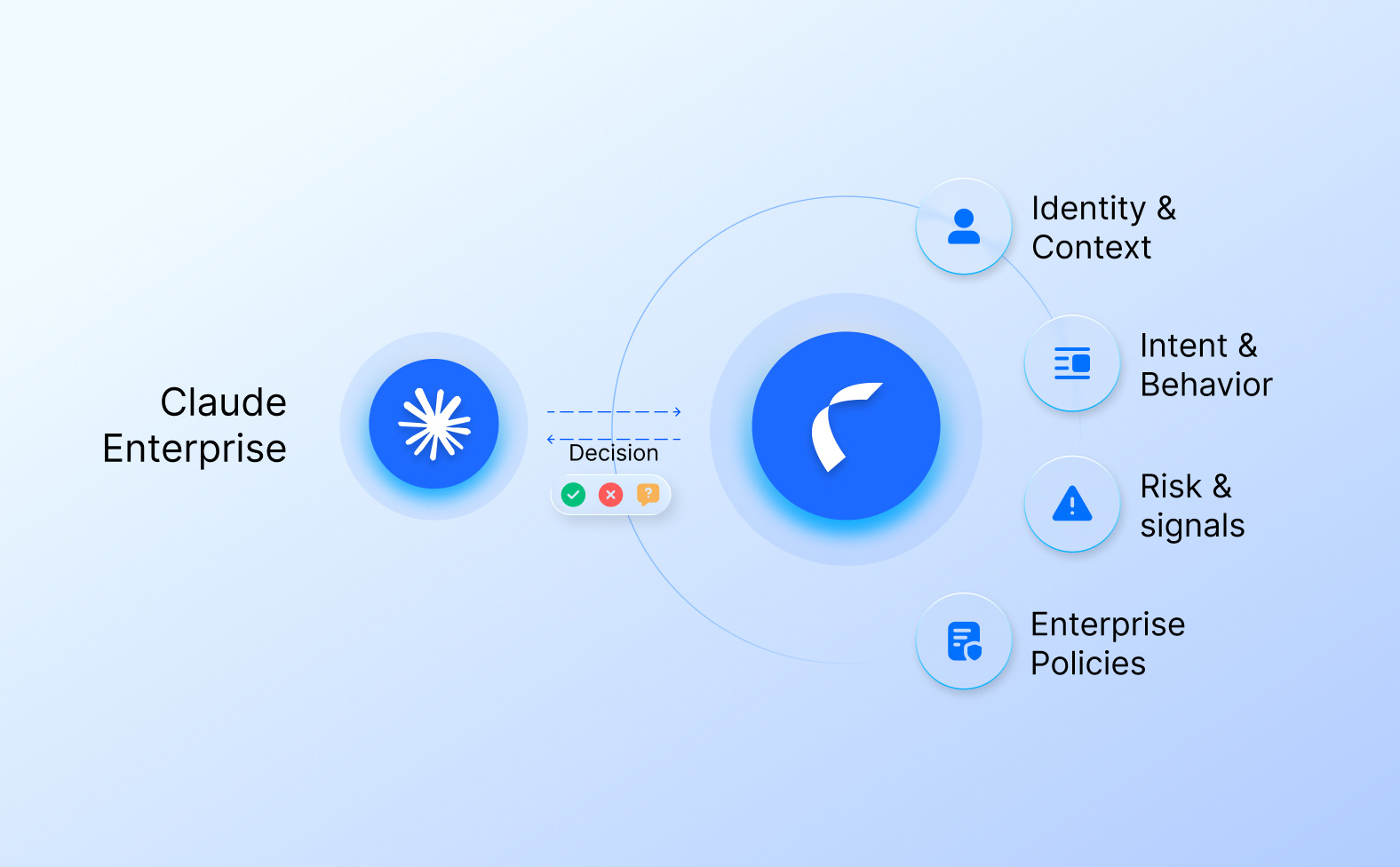
Reva places an independent runtime decision layer between the AI model and consequential actions. The model can propose a tool call, data request, production change, or external transmission; Reva decides whether that action is appropriate for the agent’s current purpose and context.
Reva’s intent-aware authorization can evaluate purpose using signals such as the user’s request, the agent’s assigned task, an active workflow, a change ticket, application context, and session history. Each requested action is evaluated against that objective, so technically valid access can still be denied when it does not support the task.
Reva’s behavior-based runtime guardrails continuously assess whether the agent is using expected tools, accessing approved resources, expanding scope, attempting to bypass a prior denial, or following a dangerous multi-step sequence. Context-aware risk evaluation adds the target environment, resource sensitivity, tool identity and version, destination, reversibility, threat signals, and potential blast radius.
Based on policy, Reva can permit an action, narrow its scope, mask, restrict, or block the disclosure of sensitive information, require additional evidence, request human approval, deny the action, revoke temporary privileges, or contain the agent session. Authorization decisions can be recorded with relevant policy context, access paths, decision reasons, and approval history for audits and incident response.
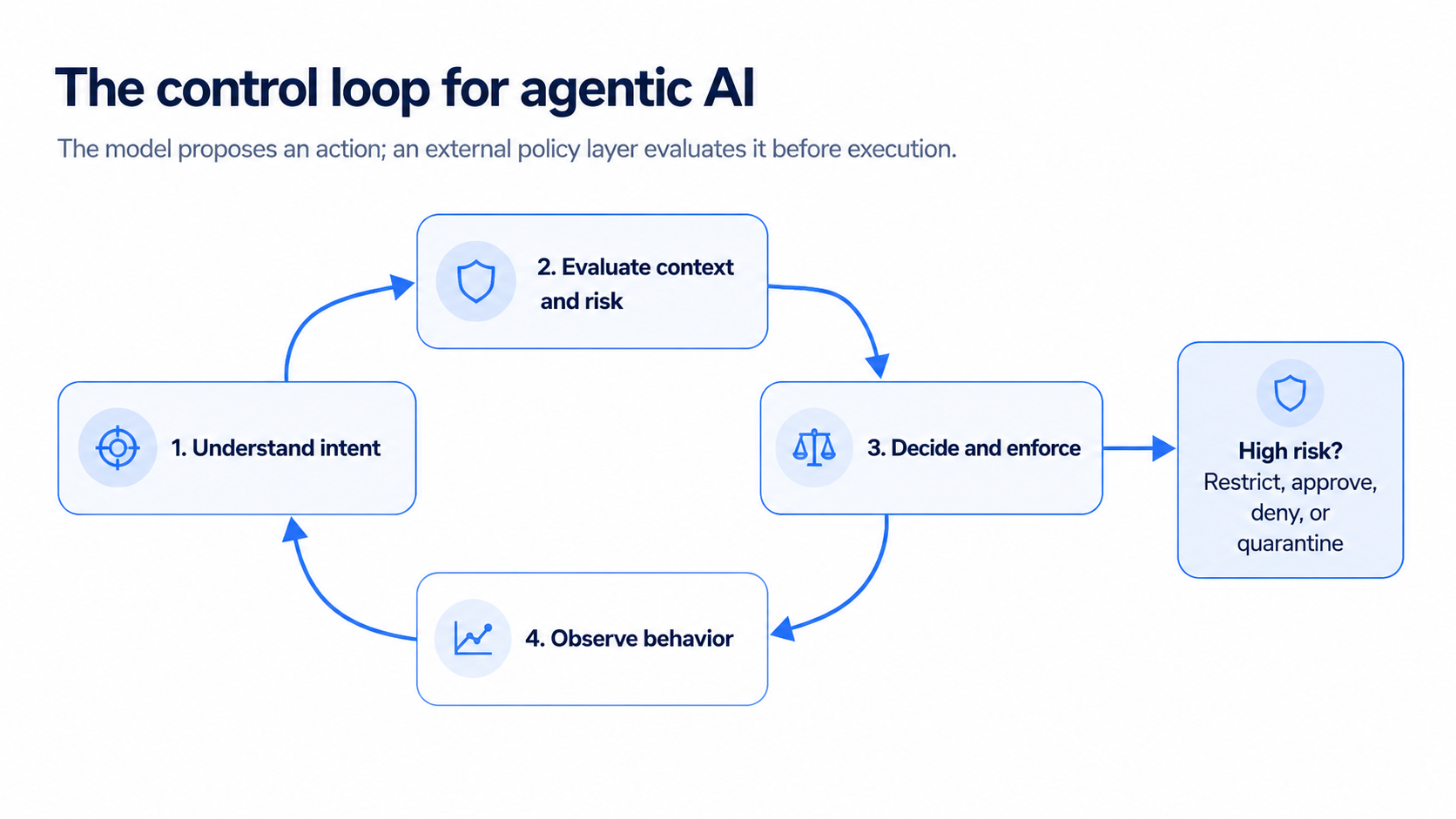
[Figure 3. Runtime authorization continuously connects intent, context, enforcement, and observed behavior]
How to start implementing Reva for AI agent security
Organizations should begin with the agents and workflows that create the greatest risk. Security teams define the business rules, sensitive resources, and approval requirements; Reva helps discover agent activity, enforce those policies at runtime, and monitor the results.
Identify priority agents and workflows. Start with agents that can access production systems, sensitive data, financial operations, external communications, or other high-impact resources. Reva can help surface the identities, tools, credentials, resources, and data flows associated with them.
Define each agent’s allowed scope. Specify the tasks an agent may perform, the tools and resources it may use, where it may send data, and how long its access should last. Reva uses this context to enforce task-specific access policies.
Separate user access from agent access. Decide which user permissions should not automatically pass to the agent. Reva can enforce temporary, task-specific privileges limited to the current task, approved resources, permitted tools, and expected duration.
Set controls for high-impact actions. Determine which actions—such as deletion, bulk changes, production deployment, privilege changes, credential access, financial activity, or sensitive data export—must be blocked or require human approval. Reva evaluates and enforces those requirements before execution.
Map hidden paths to sensitive resources. Reva’s Access Graph can reveal effective access paths, inherited permissions, latent entitlements, and other hidden authorization risks. Security teams review these findings and decide what to restrict.
Define expected behavior for important workflows. Document the expected tools, resources, data flows, action sequence, maximum scope, and completion conditions. Reva can monitor those boundaries continuously and restrict, escalate, or stop actions that fall outside them.
Test and refine the controls. Security teams should test prompt injection, malicious tool responses, cross-tool data exfiltration, task expansion, repeated actions after denial, and unauthorized production access. Reva’s results can be used to adjust policies and approval thresholds.
Measure security outcomes. Track excessive permissions discovered, high-risk actions denied, approvals requested, behavioral deviations contained, and privileges made temporary and task-specific. These metrics show whether AI agent security is becoming preventive rather than merely observable.
Bring runtime authorization to AI agent actions with Reva
AI agents introduce autonomous planning, probabilistic decisions, chained tool use, dynamic goals, and machine-speed execution. Those qualities make them useful, but they also make session-level, identity-only authorization insufficient. Reva addresses that gap by evaluating what an agent is trying to do, how it is behaving, which resource or tool it is targeting, and what impact the action could have.
The security question must follow the agent through the workflow: What is it trying to accomplish? Is this step necessary? Does the behavior match the approved process? Is the target appropriate? What is the likely impact? Reva uses those signals to determine whether the action should be permitted, narrowed, redacted, escalated, or denied.
In the agentic-AI era, least privilege can no longer mean only the fewest standing permissions assigned to an identity. With Reva, it can mean the least privilege required for this action, for this purpose, in this context, at this moment.
The model may propose the action. Reva provides the independent, explainable runtime authorization decision that determines whether it happens.